
BEE FEEDING TIPS
Feeding you honey bees on sugar syrup? What is the best ratio of sugar to water?
WHAT DO HONEY BEES EAT?
Honey bees feed on glucose, fructose, and sucrose. They are important carbohydrates, and commonly referred to as simple sugars, providing the same amount of energy, but processed differently by honey bees, and humans, tool. Glucose and fructose are found in flower nectars as well as fruits and vegetables. So is sucrose but generally in a different (smaller) proportion.
For humans, sucrose, commonly known as table sugar, is obtained from sugar canes or sugar beets. When fed sugar syrup, honey bees produce an enzyme (invertase) that converts the sucrose into fructose and glucose. The enzyme reaction takes time, just like making honey. That said, converted sugar syrup-while good for the bees, does not make honey--only a good emergency bee feed.
WHY DO WE FEED WITH SUGAR SYRUP AND NOT HONEY?
Feeding bees honey can carry bacteria spores of several brood diseases (AFB, EFB, Sacbrood). You may only feed your bees honey from your own apiary, that you know, for certain, is free of any brood disease(s) DO NOT feed bees store bought honey or honey from other beekeepers. Do not promote robbing by letting bees clean out your equipment after extracting, or leaving combs out to be cleaned. Disease can be unintentionally spread, and devastating to neighborhood colonies.
WHAT IS THE BEST RATIO OF SUGAR TO WATER?
One gallon of 2:1 (fall feeding) sugar syrup is equivalent to increasing the colony food reserves by about 7 lbs. If using jar feeders, holes in the lids should be no bigger than 1/32nds nor too small.
2:1 ratio for fall feeding.
make a 10 - dozen holes or more in the jar lids of the gravity feeders to effect a light nectar flow.
1:1 ratio for spring feeding and spraying onto package bees.
1:2 ratio for (spring or fall) brood-rearing stimulation.
make only 2 - 3 holes in the jar lids of the gravity feeders to effect a light nectar flow.
bees are only able to obtain a small amount of syrup feed over an extended period of time.
using only stored honey without access to nectar foraging does not promote brood rearing stimulation
See? Not all feeding sugar syrup is the same. Ratios are important considerations. Define your goal. Ask if it is even necessary. Over-feeding can cause a condition known as 'honey bound' and induce swarming.
Be sure to remove all feeds at least 2 weeks prior to placing honey supers on your colonies.
Feeders should be cleaned and sterilized between feedings. Mix enough syrup for immediate use only. Any syrup with evidence of fermentation or that has a sour taste should be discarded and replaced.
Your fellow beekeepers and bee enthusiasts support and thank you for following best practices!
WATER-TO-SUGAR CALCULATOR
Thank you to Richard Stewart of Carriage House Farm and the Indiana Beekeepers Association for providing this handy MS Excel spreadsheet that allows you to plug in your weights and measure for a better calculation of 1:1 and 2:1 water and sugar for sugar syrup feeding.
Download the spreadsheet to your computer.
Launch it in Excel.
Enter a number in the yelllow shaded areas... and it spits out anything you need so long as you can measure either volume or weight, you can use it to mix just about any combination.
FILE DOWNLOAD
A spreadsheet to help you calculate 'water-to-sugar' ratio (.xls download 41KB)
Feeding Bees Sugar - Best Practices Fact Sheet from UK Government (.pdf download 358KB)
NEKBA Tips for Feeding your Bees (April2024) (.pdf download)
*Open-source bee-feeding spreadsheet in MSExcel (*permission granted by original author) (.xls download)
TIPS FOR FEEDING YOUR BEES SUGAR
BEST PRACTICES & GUIDANCE
This page provides a guidance on feeding sugar to your honey bees. In the wild this is not necessary. However, with managed honey bees it is often necessary to stimulate, prevent starvation, or provide a food source during the dearth of a nectar flow. When honey is removed as a crop, it can become necessary to supplement to ensure your bees’ survival and success.
“Honey is NOT the favorite food of the honey bee! Honey is just a method of winter storage of nectar; and NECTAR is the favorite food of the bee.” — George W. Imirie, Jr. Certified EAS Master Beekeeper. 27Aug1923 – 06Aug2007
WHEN FEEDING BEES…
Make up and use feeds of good quality pure sugar. White granulated sugar is the most suitable source.
Avoid feeding honey as it carries the risk of spreading bee diseases and the scent increases the likelihood of robbing.
Use the right method, time, and type of feeder for the task.
Avoid spilling or leaving syrup open to bees in the apiary.
Take care to avoid starting any kind of robbing.
FEEDING YOUR BEES & USING SYRUP
Use feeds of good quality white sugar for syrup – most natural stimulatory feed
Cane or Beet Sugar? Sucrose is Sucrose
Avoid feeding honey to bees due to risk of disease (brood bacteria)
Use the right method, time, and feeder type for the feeding task
Do not spill or leave open (feeding) syrup to avoid robbing
Hot water and stirring help to dissolve all the crystals when making syrup
Use a 1:1 ratio(by weight) for spring feeding to stimulate wax building and growth
“As cheap as regular table sugar is in the grocery store… it is WELL KNOWN, and scientifically PROVEN, that bees winter BETTER on heavy 2:1 sugar syrup than they do on honey, because honey sometimes causes diarrhea whereas sugar never causes diarrhea. In summation, plain table sugar is the best feed for honey bees, and you vary the concentration of the sugar depending on what you are trying to HELP the bees to do“ — George W. Imirie, Jr. Certified EAS Master Beekeeper
MAKING SUGAR SYRUP…
To make sugar syrup use white granulated sugar. With modern production methods it makes no difference if it was sourced from cane or beet.
Do not use brown or raw sugars as they contain impurities.
The syrup should be made up in the proportion of 1:1 ratio by weight of white granulated sugar to warm water. There is no need to boil the mixture but using hot or warm water helps. Stir regularly to remove the air bubbles and dissolve all crystals. When fully dissolved the mixture is clear and a very pale straw color.
If syrup is stored for any length of time then a scummy black fungal growth may appear. This can be prevented by adding a little thymol. Thymol does not dissolve readily in water, but a solution can be made up in a small sealable bottle. Fill it to one third with thymol crystals* and top the bottle up with surgical spirit. Add 2.5 ml. of this solution to 4.5 l. of sugar syrup or half a teaspoon to a gallon of syrup. *Obtainable from bee equipment suppliers.
For some feeding, usually when it is for immediate use by the colony, thin syrup is used. This contains twice the quantity of water and is best made up for use as required.
Sugar syrup can be stored and moved around in suitable clean plastic drums. In the apiary a plastic watering can is a useful device for filling feeders.
BEE SUGAR SYRUP FEEDER TYPES
There are three basic types of feeders used to feed sugar syrup to honey bee colonies.
TOP FEEDERS
Top feeders in the U.S. comprise a tray which is placed over the hive to which bees have access from below by means of a hole or slot arranged to stop them drowning. These are made to the same external dimensions of the hive and are placed on top of the hive in lieu of the inner cover. They can feed up to about 10 quarts. (or just over two gallons) at a time. Smaller plastic versions are available for placing over the inner cover board feed hole.
Top feeders are ideal for feeding bees in the autumn but are of less use in very cold conditions. When filling rapid feeders, a small quantity of syrup is trickled down the side of the hole or slot to create a trail for bees to follow. Because of their large capacity these types are more convenient for autumn feeding.
CONTACT FEEDERS
These are plastic buckets of various sizes fitted with a lid having a gauze center section. In use they are either filled with sugar syrup, or the syrup is mixed in the bucket. The lid is placed on the feeder to seal it up. In the apiary the feeder is inverted over an empty container to catch the small amount of syrup that will pass through the gauze before atmospheric pressure in the bucket drops thus holding the syrup in the feeder. It is then placed on the hive with the gauze patch over the crown board feeder hole. An empty brood box, super or eke will be needed to support the hive roof properly. Contact feeders are generally more accessible to bees in cool weather conditions as the feeder is closer to the nest, making them more effective for emergency and spring feeding.
FRAME FEEDERS
These are containers that look like a brood frame with a slot at the top and have a float inside to prevent bees drowning. They are filled by pouring prepared syrup through the slot. Typically, they are used to supplement the food and replace a frame within the brood box. In the UK they are mostly used for keeping nuclei ‘topped up’ and in queen rearing systems.
There are other types of feeders, but these are not in common use.
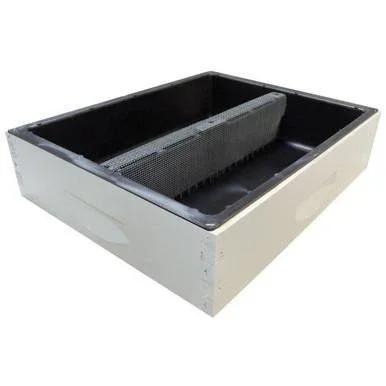
Top/Frame Feeders
Ideal for spring thru fall but not necessarily in cold weather
Tray above the hive
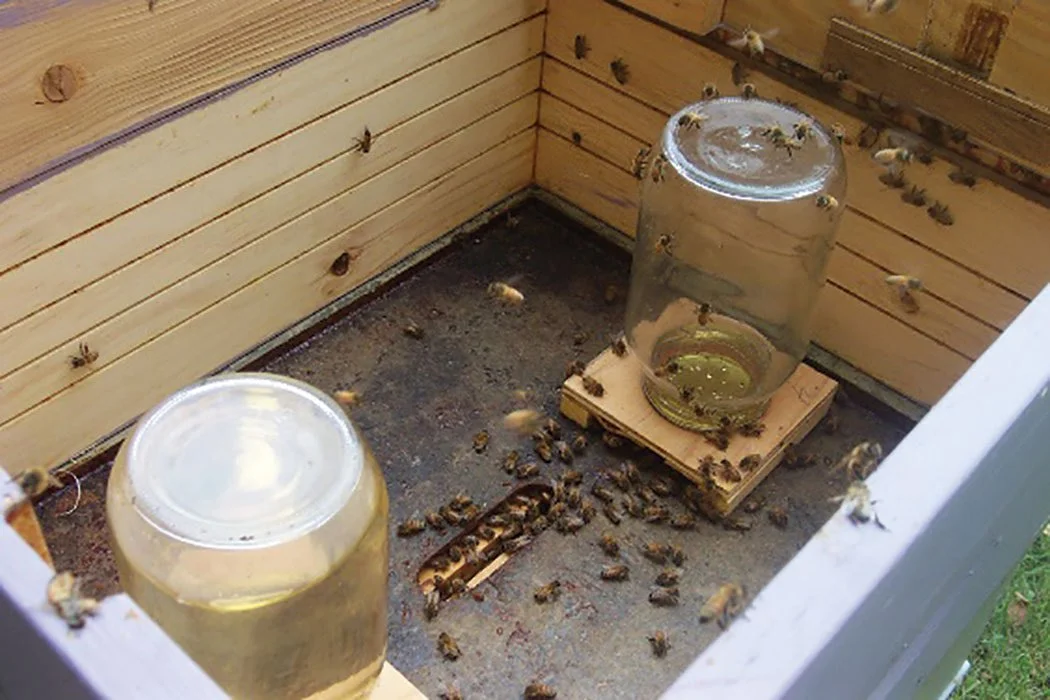
Contact Feeding
Accessible in cool and cold weather and better for emergency
Need empty box
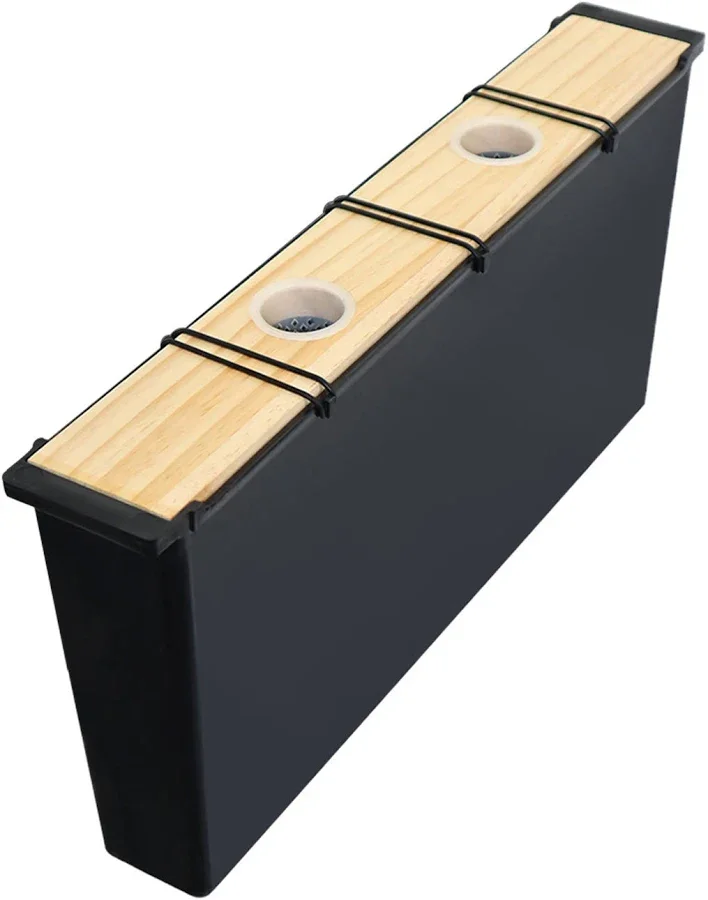
Frame Feeding
Looks like brood frames
Need to access by opening the hive
FEEDING SUGAR CAN BE DIVIDED INTO THREE TYPES.
SPRING OR STIMULATIVE FEEDING
Many beekeepers feed a thin syrup solution to encourage brood rearing but providing the colony has sufficient stores, as stated previously, this is arguably pointless.
It is a good plan to breed bees for the honey flows rather than breeding bees on the honey flow.
To rear brood, bees need to feed a mix of honey or sugar, water, and pollen, so to encourage brood rearing:
Ensure that the colonies are close to pollen crops or feed pollen.
Ensure that the colonies have sufficient honey and/or sugar syrup stores. If not feed a thin syrup.
Ensure that the bees have access to a clean water supply. If necessary use a water feeder.
EMERGENCY FEEDING
These procedures are best practiced by avoiding starvation.
Bees can starve at any time of the year and usually if this happens it is the beekeeper and not the bees who should take the blame. It is the responsibility of the beekeeper to make sure that bees have enough stores.
Sometimes in winter bees use up stores on one side of the hive and become marooned away from stores elsewhere. This is known as isolation starvation. Frames of stores can be moved across, so they are adjacent to the bee cluster. Do not divide the brood nest.
If bees are short of stores in the winter and likely to starve then soft white candy (bakers fondant) is placed over the crown board feed hole. In the case of small colonies, the crown board may need turning in order to position a feed hole over the bee cluster. Bees require water, often taken as condensation within the hive, to make use of candy. Candy is therefore taken slowly and does not excite the colony as much as other feeds. If sugar syrup is offered in a contact feeder cold temperature may cause contraction of the container pushing syrup through the mesh and a wetting of the cluster. Correct autumn feeding prevents this scenario.
If bees are short of stores at the spring inspection then feed thin sugar syrup using a contact feeder.
In extreme cases when bees are starving spray them with a thin sugar syrup solution and fill an empty comb with sugar syrup. This can be done by pouring the syrup into the cells slowly by using a honey jar filled with sugar syrup and closed with a lid having 3 mm holes on opposite sides, or using a squeezy bottle, e.g. a cleansed washing up fluid bottle. When filled, place the comb adjacent to the bees.
Remember March and April are the months when the bees will be using up food reserves fast as the colony expands and produces more brood. It is far better to have fed sufficient stores or left lots of honey in the autumn than to do emergency feeding in the spring. At this time a colony should have at least 4-5 combs with honey/stores, i.e. 9 kg. or 20lb.
When removing a honey crop always check that sufficient stores remain to prevent bees starving. Feed immediately if needed.
AUTUMN FEEDING
As a rule, bees only need feeding because a crop of honey has been removed by the beekeeper. When taking a crop ensure that the bees have sufficient stores left in the hive to prevent starvation.
September is generally the time of year chosen to feed sugar syrup as a supplement or substitute to ensure that honey bees have sufficient stores to carry them through the winter. Feeding is done after the honey crop has been removed and whilst the colony is still strong, warm enough for bees to move up into the feeder, able to take syrup down, invert and store it properly in the comb.
Earlier feeding tends to be converted into brood so unless there is a risk of starvation wait until September.
The number of stores required by a colony to carry it through the winter varies with the strain of bee. The old British black, Apis mellifera, only required about 10 kg. of honey to safely feed it through the winter, but today an average honeybee colony requires about 18–22 kg. or 40- 50lb. to do so. Larger hives headed by prolific queens may require more. A British Standard brood frame when full of honey contains about 2.2 kg. or 5lb. so assess the existing colony stores and feed the required balance using sugar syrup.
Feeding at the time of some varroacide applications, usually those containing essential oils, is discouraged as this may increase robbing risks. Check the varroacide directions.