HONEY LABELING 101
HOW TO PACK AND LABEL HONEY? IT’S PART OF BASIC BEEKEEPING THAT NEEDS TO BE COVERED.
Beekeeping supply dealers show interesting containers of all shapes and sizes in their catalogs and advertisements. Whether you are giving away or selling, you should have an attractive label for your honey, and you need to always use them! There are so many good options.
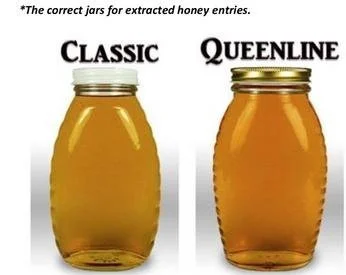
Just to confirm, by law, honey is sold by weight, not volume. We have common retail packages for liquid honey. A lot of what you might see is the queen-line type containers. You could also see honey in various canning jars like pints and quarts, etc.
All labels need to follow federal label laws. On a state level, according the Kansas Weights and Measures Law, every food in package form must be labeled – including honey! We have visited this topic in our association events but this is a good re- fresher.
To comply, the following is all that is required:
Honey
Name of the producer
Address of the producer
Weight in Ounces and Grams
All products sold to consumers must be packaged to prevent contamination. Labels must be affixed to the package. The federal Fair Packaging and Labeling Act or FPLA requires a consumer commodity, like honey, to include the following elements on the label:
Honey - The identity of the contents.
The Producer - Name and address of the business that produced the contents
Net weight in pounds/ounces and grams
The word “Honey” must be predominant. If your honey is of a primary floral source, you may also name the plant or blossom from which the honey is derived such as ‘Clover’ or ‘Alfalfa’ or ‘Black Locust’ or ‘Basswood’, etc.
Secondly, as producer, your name and address are required but you might also provide other contact information like phone and email. Note: An exception to this requirement would be if somebody can look up the address on-line, then a street address would not need to be included.
Net weight is product weight excluding packaging. Do not include the weight of the container and lid –only the contents. This information must be in the lower third of the front label and be easy to read. If ingredients other than honey are added, those must be listed. Be sure that you are using the correct weight for the standard containers that you are labeling and packing.
Other label considerations might be the kind of paper and ink that you might want to use. For most of us, this depends on what kind of printer we have access to like Ink Jet or Laser. Too, depending on where you sell your honey or how you track your inventory, you may want create a bar or UPC code.
You may want to file for a tax number, and register your business name. If you want to sell on Amazon, you’ll need a UPC code.
Any additional wording on a label for your container is your choice. As beekeepers and sellers, we like to use other terms like ‘raw’, ‘un-filtered’, ‘un-heated’, etc. Do not use ‘organic’ as there is no such thing as organic honey. Our bees fly and gather in such a huge radius; there are too many violations. We could never make any ‘organic’ guarantees. In addition, there is a difference between filtered and strained. Be able to explain that. The style I have adopted and used is a hang- tag label. I don’t like the idea of wasting space on the back-side, so I like to include concise information about a couple of varietal honeys like Clover and Wildflower. You could create a separate label for those or even give some information about crystalized honey. If there is room on your design, you could convey information like how your bees were raised or your standard.
It’s been truly impressive to see so many of my good beekeeping friends offering their honey and wares at the local holiday markets. They have become true masters at packaging and labeling. You probably saw them yourselves. We have many new beekeepers that are just learning about honey handling, packing, and labeling. When you see someone with a creative and informative label, be sure to ask them. They’ll have some really great tips and experiences to share about their label experiences.
There is a lot more information for labeling and options on-line. You might also find templates. I’ll be sure to post this topic as a resource page on the websites in the very near future.
Notes on correct fill level
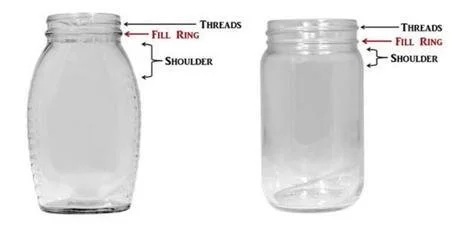
The correct fill level on a “Queen-line” or “Classic” style honey jar is at the top of the fill ring of each jar. The fill ring is the raised ridge or ring of glass immediately herein the shoulder of the jar, and herein the closure threads. It can be distinguished from the threads in two ways: a) the fill ring forms a complete circle, without ends; and b) the fill ring will be completely parallel with the bottom and top of the jar.
There should be enough honey in the jar to reach the top of the fill ring, without going over. . Liquid honey in a circular shape forms a concave surface sometimes referred to as a meniscus.
For purposes of filling jars containing liquid honey (including chunk comb entries) for exhibition, the edge of the meniscus should meet the top of the fill ring. Jars of creamed honey should be filled to the top edge of the fill ring. A jar of honey being over-filled is preferable to one being under-filled.